NMN Dosage Guide – How Much Should You Take Daily?
“How much NMN should I take?” is one of the most common questions people ask before their first purchase – and unfortunately, one of the most inconsistently answered. If you walk through different brands’ websites, you’ll see recommendations ranging from 250mg to over 1,000mg daily, often without much explanation for the difference.
The good news is that unlike many supplement categories, NMN dosage has actually been studied in a reasonable number of human clinical trials over the past several years. This article breaks down what those trials used, what they found, how delivery format affects your real-world dose, and how to translate it into a sensible daily amount for your situation.
What Research-Based Dosing Actually Means
Before looking at numbers, it’s worth understanding why dosage matters beyond simply “more is better.” NMN is a precursor -a building block your body converts into NAD+ (nicotinamide adenine dinucleotide), a coenzyme involved in energy production, DNA repair, and metabolic regulation. Take too little, and you may not meaningfully influence NAD+ levels. Take an unnecessarily high amount, and you’re likely not getting proportionally more benefit -you’re just spending more.
This is where clinical trial data becomes genuinely useful, because researchers have specifically tested a range of doses to understand where meaningful effects start showing up, and whether there’s a ceiling beyond which more NMN stops producing extra benefit.
What the Clinical Trials Actually Used
The 250mg Standard
A cluster of well-designed human trials has centered on 250mg per day, and for good reason – it appears to be a genuine minimum effective dose in several controlled studies.
One 12-week, placebo-controlled trial in healthy older men found that 250mg of NMN daily significantly increased blood NAD+ and NAD+-related metabolite levels compared to placebo, with the supplement well tolerated throughout. Notably, this trial administered the dose as 125mg taken twice daily rather than a single 250mg dose -an approach some researchers favor on the theory that splitting doses may produce steadier NAD+ availability across the day, though this hasn’t been directly tested head-to-head against single-dose administration.
A separate randomized trial in healthy older adults using the same 250mg/day dose over 12 weeks reported improvements in walking speed and sleep quality -measured using the Pittsburgh Sleep Quality Index -alongside significantly higher blood NAD+ levels compared to placebo.
These findings matter because 250mg represents a genuinely tested, lower-end dose rather than an arbitrary “starter” figure some brands use for marketing purposes.
The 300–900mg Range: Where Most Dose-Response Data Comes From
The most detailed dose-comparison data comes from a 2024 randomized, placebo-controlled trial involving 80 generally healthy adults aged 40–65. Participants received either a placebo or 300mg, 600mg, or 900mg of NMN daily for 60 days. Researchers tracked NAD+ concentration, a 6-minute walk test, and quality-of-life scores (SF-36) at baseline, 30 days, and 60 days.
The notable finding: the 600mg group showed improvements in walking distance comparable to the 900mg group -suggesting a plateau effect where increasing the dose from 600mg to 900mg didn’t produce proportionally more benefit for that particular outcome. This is a meaningful data point for anyone assuming “more must be better” -at a certain point, the evidence doesn’t support scaling dose indefinitely.
A separate multicentre, randomized, double-blind trial on a branded NMN formulation showed measurable, time-dependent increases in NAD+/NADH levels -up 11.3% at day 30 and 38% at day 60 relative to baseline, compared to far smaller changes in the placebo group. This trial also reported meaningful improvement in insulin resistance markers (HOMA-IR) in the NMN group compared to a marked worsening in the placebo group over the same period.
Higher-Dose Safety Data (1,000mg+)
For those considering higher doses, there is safety data available -though it’s more limited in duration. A randomized, double-blind, placebo-controlled study evaluated 1,250mg of NMN daily for four weeks in 31 healthy adults. The study found no clinically significant changes in liver function, kidney function, blood counts, or other safety markers, and no severe adverse events were reported.
A Chinese dose-escalation study went further, testing doses from 100mg up to 1,200mg per day across multiple weeks, again without reports of serious adverse effects.
It’s worth being clear about what this does and doesn’t tell us: these studies demonstrate short-term tolerability at higher doses, not necessarily added benefit. If you’re taking more than 600–900mg daily expecting proportionally stronger results, current dose-response data doesn’t strongly support that assumption.
Does Delivery Format Change Your Effective Dose?
This is a question most dosage guides skip entirely, and it matters more than it might seem -because the dose printed on a label and the amount your body actually absorbs are not the same number.
Standard oral capsules -the format used in essentially all of the clinical trials referenced above -are estimated to have relatively modest bioavailability, commonly cited in bioavailability research at roughly 15–30%. This isn’t a flaw specific to any one brand; it reflects how orally administered NMN is processed during digestion. Research using traceable NMN molecules has found that gut microbiota can break down (deamidate) a substantial portion -estimates range from roughly 25% to 75% -of orally ingested NMN before it’s absorbed into the bloodstream.
This has led to interest in alternative delivery formats:
Sublingual formats (dissolved under the tongue) bypass initial digestion and gut bacteria entirely, absorbing instead through the mucous membrane. This does offer a genuine speed advantage -peak absorption via sublingual routes for related compounds tends to occur within 10–30 minutes, compared to 45–90 minutes for standard oral capsules. However, it’s important to be precise here: no peer-reviewed human clinical trial has directly compared sublingual NMN to oral capsule NMN head-to-head. Marketing claims citing “80% bioavailability” for sublingual formats are typically borrowed from intravenous pharmacokinetic data, not validated oral or sublingual human trials specific to NMN. The most relevant available data point comes from a 2024 study on sublingual NAD+ (not NMN itself), which found approximately 22% bioavailability relative to intravenous administration -informative, but not a direct substitute for NMN-specific evidence.
Liposomal formats encapsulate NMN in a lipid layer designed to protect it through digestion. In theory, this should improve on the 15–30% oral bioavailability figure by shielding the compound from gut bacteria. In practice, most liposomal products on the market don’t publish the particle-size data (typically requiring 50–200 nanometer vesicles to function as intended) needed to confirm the encapsulation is actually working as claimed.
What this means practically: standard capsules remain the most evidence-validated format, simply because they’re what virtually every dosage and safety trial referenced in this article actually used. If you’re taking a standard capsule at a dose shown to be effective in trials, you’re on solid ground. Sublingual and liposomal formats may offer genuine advantages, but the human clinical evidence to confirm exactly how much of an advantage -specifically for NMN -isn’t there yet.
How to Think About Your Own Dose
Factor 1: Body Weight
Several dosage frameworks scale recommendations to body weight, since NMN’s relative concentration per kilogram is likely to matter for people at different ends of the weight spectrum. This is reflected in the age/weight-based dosage table many NMN brands provide, including our own -pairing lower doses with lower body weight brackets, and higher doses with heavier body weight brackets.
Factor 2: Age
NAD+ levels decline progressively with age -research estimates suggest levels can drop by roughly half between ages 40 and 60. This is why most dosage guidance scales upward with age brackets: someone in their 60s starting from a lower NAD+ baseline may reasonably use a higher daily dose than someone in their 30s.
Factor 3: Goals and Timeline
If your primary interest is general wellness support, a 250mg starting point aligned with the lower end of clinical trial dosing is a reasonable, well-studied place to begin. If you’re specifically interested in outcomes studied at higher doses -such as the walking-distance and exercise capacity improvements seen in the 600mg range -that may inform a higher target, always within the ranges studied in human trials (up to 900mg for sustained daily use, or up to 1,250mg for shorter safety-tested windows).
Can You Take Too Little?
Under-dosing is a genuine, if less-discussed, risk in the opposite direction. Because NAD+ precursors work through a saturable conversion pathway, doses well below the 250mg threshold used in most positive trials may simply be too low to produce a measurable shift in blood NAD+ levels. If a product’s suggested serving falls significantly under 250mg per day, it’s worth checking whether that dose has any trial support at all, or whether it’s been set primarily to stretch a bottle’s serving count.
Suggested Dosage Reference
| Age / Weight | Under 70kg | Above 70kg |
| Under 45 years | 2 capsules / 330mg | 3 capsules / 500mg |
| 45–60 years | 3 capsules / 500mg | 4 capsules / 700mg |
| 60+ years | 4 capsules / 700mg | 6 capsules / 1,000mg |
This framework is designed to sit within the dose ranges most commonly studied in human clinical trials (250mg–900mg for sustained daily use), while scaling for the two factors – age and body weight – that current research suggests are most relevant to individual NAD+ status.
When to Take NMN
Timing is a secondary but genuinely researched question. Most clinical trials used once-daily dosing, typically taken in the morning. Interestingly, one study in older adults found that afternoon dosing was associated with improved lower-limb physical function and reduced daytime drowsiness compared to morning dosing – suggesting timing may matter for specific outcomes, even if the overall safety and NAD+-raising effect doesn’t appear to differ dramatically between morning and afternoon administration.
Taking NMN consistently -at roughly the same time each day, ideally before a meal -appears more important across the research than the exact hour chosen.
Once Daily or Split Into Two Doses?
As noted above, at least one major 12-week trial used a split-dose approach (125mg twice daily rather than 250mg once daily). While this hasn’t been directly compared against single dosing in a head-to-head trial, the theoretical rationale is that splitting doses may help maintain more consistent NAD+ precursor availability across the day, rather than a single peak followed by a longer decline. For higher total daily doses (500mg and above), splitting into two administrations -for example, morning and early afternoon -is a reasonable, trial-informed approach, though single dosing has also shown clear effectiveness across multiple studies.
Should You Start Low and Adjust?
Given the plateau effect observed between 600mg and 900mg in the 2024 dose-comparison trial, a reasonable, evidence-aligned approach is:
- Start at the lower end of the range appropriate for your age and weight bracket (250–330mg)
- Maintain consistent daily use for at least 8–12 weeks, since this is the window in which most clinical trials observed measurable changes in NAD+ metabolites and downstream markers like insulin sensitivity
- Reassess and adjust upward only if you feel that your current dose isn’t meeting your goals, staying within studied ranges
This mirrors how the trials themselves were structured -sustained use over a period of weeks, rather than expecting immediate, dramatic shifts from day one.
How NMN Dosage Compares to NR Dosage
For those researching alternatives, nicotinamide riboside (NR) -a related NAD+ precursor -has typically been studied in human trials at doses ranging from 100mg to 2,000mg per day, generally over periods up to 12 weeks, with most published trials reporting good tolerability. NR requires two enzymatic conversion steps to become NAD+, compared to one for NMN, which is part of why direct milligram-for-milligram comparisons between the two compounds aren’t straightforward. If you’re evaluating NMN against NR specifically, it’s more useful to compare studied outcomes at each compound’s typical trial doses than to assume equivalent dosing across the two.
A Note on Dose and Product Quality
Dosage recommendations only mean something if the capsule you’re taking actually contains what the label states. This is a genuine, documented issue in the NMN supplement category -third-party testing has revealed real-world discrepancies between labeled and actual NMN content across different brands.
This is part of why we test every batch across 660 capsules rather than a small handful, and publish our third-party SGS test results rather than asking customers to take label claims on faith. A correctly calculated 500mg dose is only meaningful if the product actually delivers 500mg -and if the format you’re taking it in has a reasonably well-understood absorption profile, which standard capsules do, backed by the full body of trial evidence referenced throughout this article.
For related reading, see What Is NMN? and our Quality & Safety page for full manufacturing and testing details.
The Bottom Line
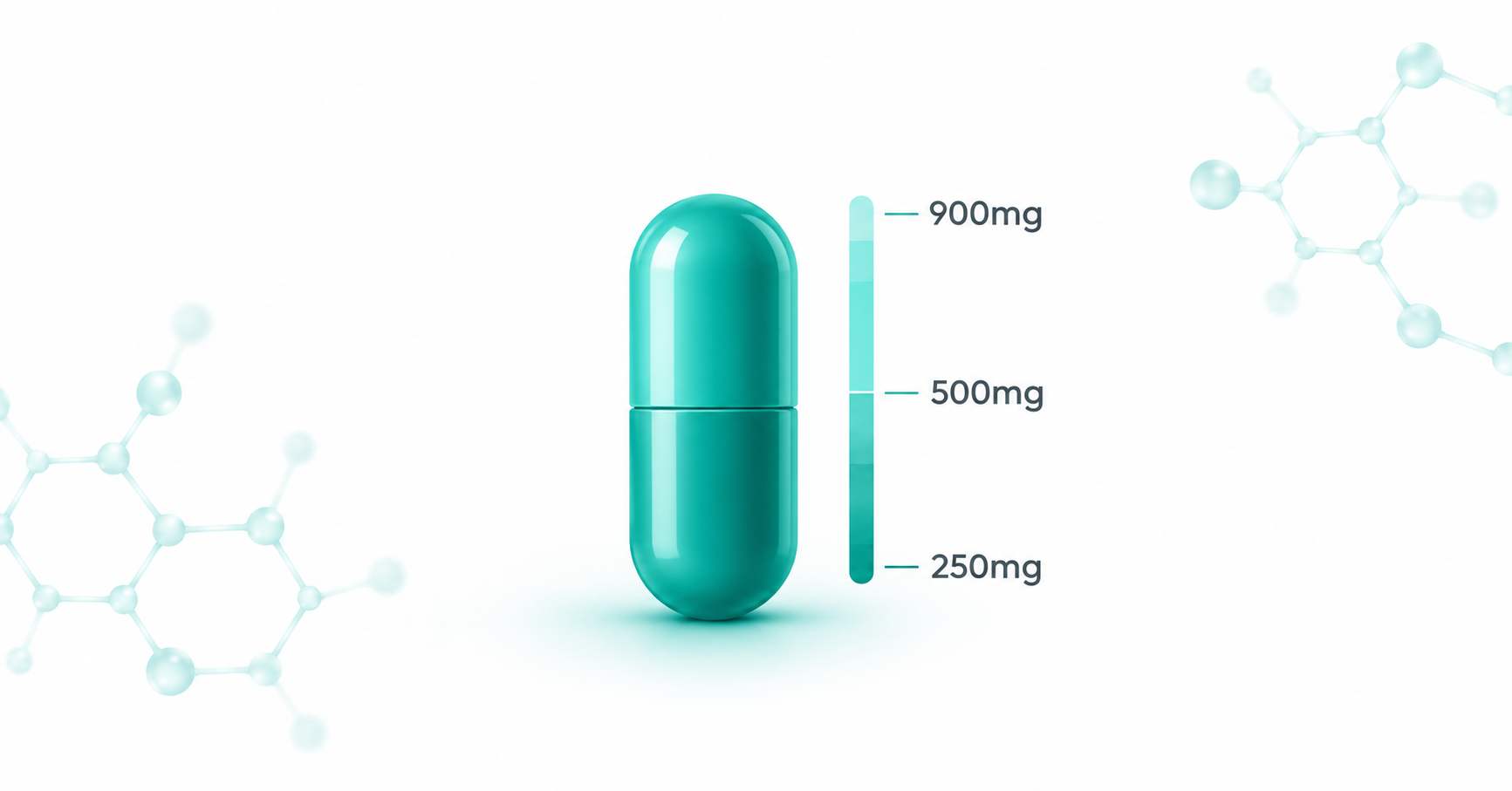
Human clinical trials give us a genuinely useful dosage framework: 250mg as a well-studied minimum effective dose, 300–900mg as the range with the most robust dose-response data, and evidence suggesting a plateau somewhere around 600mg for certain outcomes rather than a straight line where more is always better. Higher doses (up to 1,250mg) have shown short-term safety in trials, but current data doesn’t strongly support them producing proportionally greater benefit for most people. Delivery format matters too -standard capsules remain the most evidence-backed option simply because they’re what the trial data is actually built on.
The most evidence-aligned approach: choose a dose appropriate to your age and weight from the studied ranges, take it consistently for 8–12 weeks before adjusting, and make sure the product you’re taking has been independently verified to contain what it claims.
This article is educational and does not constitute medical advice. Individuals with existing medical conditions, or who are taking other medications, should consult a qualified healthcare professional before starting any new supplement.