How Long Does NMN Take to Work? A Realistic Timeline
One of the most common sources of disappointment with any supplement – NMN included – comes from mismatched expectations about timing. If you’re expecting a dramatic transformation within a few days, you’re likely to conclude it “isn’t working” long before it’s had a realistic chance to. This article works through what clinical research actually shows about NMN’s timeline, broken into distinct phases so you know what to reasonably expect, and when – including what happens if you eventually stop.
Why Timeline Expectations Matter
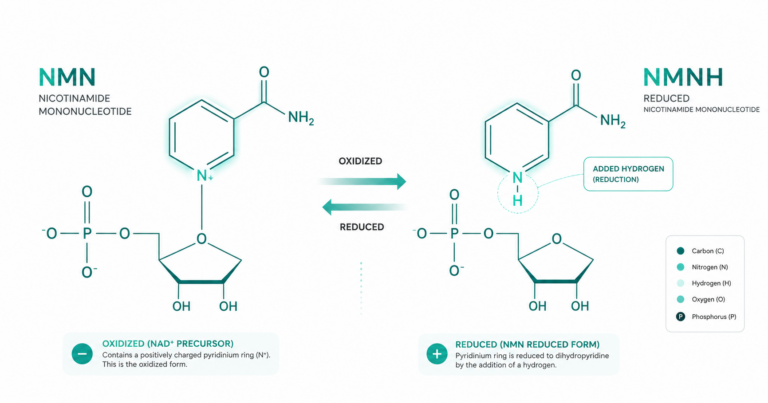
NMN is a precursor – your body converts it into NAD+, which then supports a wide range of ongoing cellular processes, including energy metabolism, DNA repair, and mitochondrial function. This is fundamentally different from a stimulant that produces an immediate, noticeable effect. The relevant question isn’t “when will I feel something,” but “over what timeframe do measurable biological changes actually occur,” according to controlled research.
Phase 1: Days 1–7 – Biochemical Changes Begin, But Aren’t Yet Noticeable
At the cellular level, NAD+ levels can begin shifting relatively quickly after NMN intake starts. However, “measurable in a blood sample” and “noticeable in daily life” are two very different things. In this earliest window, most published trials are not looking for – or reporting – subjective changes; they’re establishing baseline safety and beginning to track NAD+ metabolite levels.
Some individuals do report subtle shifts in energy within the first one to two weeks, but this is based on self-reported user experience rather than the controlled trial data specifically measuring this timeframe. It’s reasonable to treat early impressions as provisional rather than conclusive.
Phase 2: Weeks 2–4 – Early Trial Data Starts to Show Movement
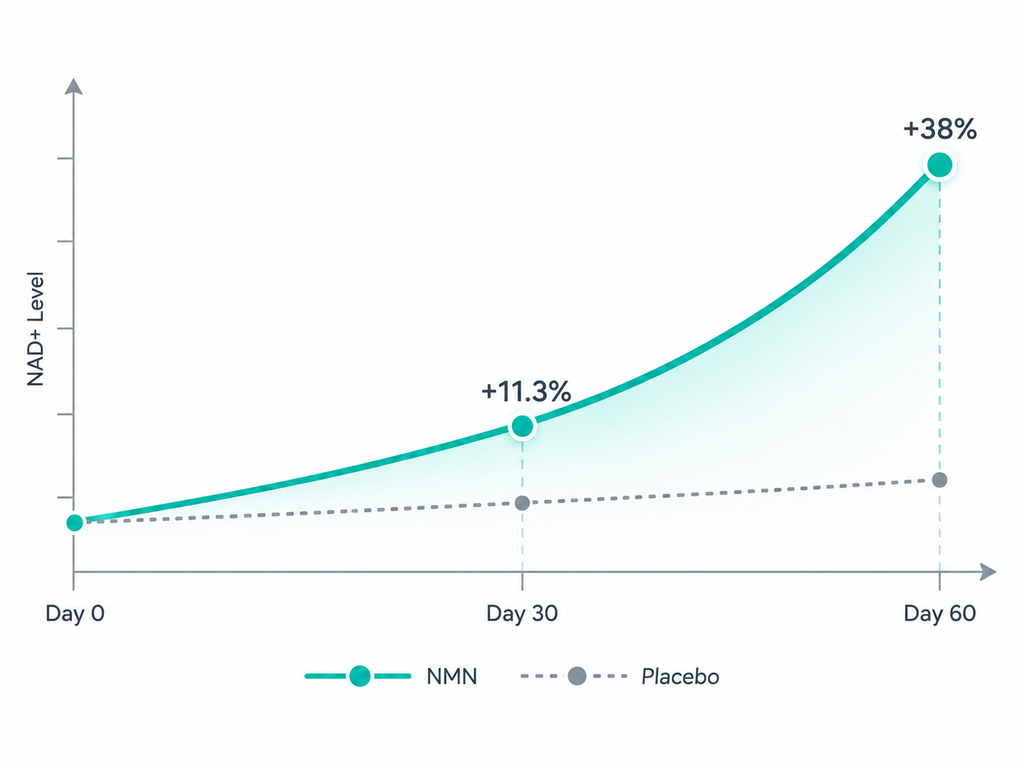
This is where the first genuinely controlled data points start to appear. A multicentre, randomized, double-blind trial tracking a branded NMN formulation found that serum NAD+/NADH levels had already increased by 11.3% at the day-30 mark, compared to no meaningful change in the placebo group over the same period.
This tells us something important: measurable, statistically distinguishable changes in NAD+ metabolism are achievable within the first month of consistent use – but at this stage, the changes are typically still building rather than fully realized.
Phase 3: Weeks 6–8 – Where Most Trials Begin Reporting Consistent Effects
By the six-to-eight week mark, several independent trials begin reporting effects beyond just NAD+ blood levels. A 12-week, placebo-controlled trial in healthy older men supplementing with 250mg of NMN daily found sustained, significant increases in NAD+ and NAD+-related metabolites, with researchers noting the supplementation was well tolerated across the study duration – with continued increases visible when comparing 6-week and 12-week intervals within the same trial.
A systematic review pooling ten randomized controlled trials – 437 total participants, with a mean follow-up duration of 9.6 weeks – found this window (roughly 4 to 12 weeks) to be where the overwhelming majority of published NMN research reports its outcome measurements. This isn’t a coincidence: researchers have converged on this timeframe because it’s where measurable, replicable effects tend to emerge.
Phase 4: 8–12 Weeks – Where the Clearest Outcome Data Appears
The most detailed data point comes from the same multicentre trial referenced above: by day 60, NAD+/NADH levels had increased by 38% from baseline – more than triple the day-30 figure – compared to just 14.3% in the placebo group over the same period. This trial also reported that insulin resistance markers (HOMA-IR) improved by 0.6% in the NMN group, while the placebo group’s insulin resistance worsened by 30.6% over the same 60-day window.
Separately, a six-week trial in amateur runners taking 300mg, 600mg, or 1,200mg of NMN daily found a dose-dependent improvement in aerobic exercise capacity – demonstrating that performance-related outcomes, not just blood biomarkers, can shift within this same general window when the outcome being measured is training-responsive.
Quality-of-life measures (SF-36 scoring) in the multicentre trial also showed a modest increase in the NMN group by day 60, compared to a smaller change in the placebo group – suggesting that subjective wellbeing metrics tend to lag slightly behind the underlying biochemical changes, becoming more apparent as the supplementation period extends.
What This Means in Practice
Based on the pattern across these trials, a realistic expectation timeline looks like this. In weeks 1–2, biochemical changes begin at the cellular level, and noticeable subjective effects are unlikely and shouldn’t be expected yet. In weeks 3–4, measurable increases in blood NAD+ levels become detectable in controlled studies, and some users report subtle shifts in energy, though this varies significantly between individuals.

In weeks 6–8, most published trials begin reporting statistically significant, sustained effects, both in blood biomarkers and, in some cases, physical performance metrics. In weeks 8–12, the most substantial documented changes appear – NAD+ increases roughly triple from the 30-day mark to the 60-day mark in the most detailed trial data available, alongside measurable improvements in metabolic markers like insulin sensitivity. Beyond 12 weeks is genuinely under-researched territory – the longest published randomized controlled trials for NMN run approximately 12 weeks, so claims about effects beyond three months aren’t currently backed by the same level of controlled evidence as the earlier windows.
Factors That Influence Your Personal Timeline
Dose consistency matters more than dose size. The trials showing the clearest results involved daily, uninterrupted supplementation. Sporadic use is unlikely to replicate trial conditions, regardless of the dose taken on any single day.
Baseline NAD+ status also plays a role. Since NAD+ naturally declines with age – with research estimating roughly a 50% reduction between ages 40 and 60 – someone starting from a lower baseline may notice proportionally larger relative changes than someone younger with higher existing NAD+ levels.
Individual metabolic variation is a factor that’s harder to control for but worth acknowledging. Two people taking an identical dose won’t necessarily convert NMN to NAD+ at the same rate – differences in gut microbiota composition, baseline metabolic health, and genetic variation in the enzymes responsible for NAD+ synthesis can all influence how quickly measurable changes appear. This is part of why clinical trials report results as group averages with a spread around them, rather than a single fixed number that applies identically to everyone. If your personal timeline runs slightly faster or slower than the averages described here, that alone isn’t unusual, and it doesn’t necessarily mean the product or the underlying science isn’t working as expected for you specifically.
What outcome you’re tracking matters too. Blood NAD+ levels, subjective energy, exercise performance, and metabolic markers like insulin sensitivity don’t necessarily move at the same pace. The performance-based improvements seen in the runner’s trial emerged over six weeks specifically because the outcome (aerobic capacity) is inherently trainable and responsive; a slower-moving marker like long-term metabolic health may take the fuller 8–12 week window to show change.
Product quality and actual dose delivered matter as much as any of the above. None of this timeline data means anything if the product you’re taking doesn’t contain the NMN content stated on the label. This is a documented, real issue in the category – which is why we test every batch across 660 capsules and publish our third-party SGS testing results rather than asking customers to assume label accuracy.
For related context on dosage and how it interacts with your personal timeline, see our NMN Dosage Guide, and for a broader look at the underlying science, visit The Science.
How to Track Whether NMN Is Working for You
Given that many of the changes documented in trials are internal and gradual rather than immediately felt, relying purely on subjective impressions can be an unreliable way to judge progress – especially in the first month, when the clinical data shows changes are still building. A more objective approach borrows directly from how the trials themselves measured outcomes.
The most direct option is a blood-based NAD+ level test, now offered by a number of specialty labs, which gives you an actual before-and-after comparison rather than a guess. Testing once before starting, and again at the 8 to 12 week mark that the research points to as the most informative window, mirrors exactly how the clinical trials referenced throughout this article were structured.
A second, more accessible option is simply tracking a small set of consistent proxy measures over the same timeframe – resting energy levels on a simple 1–10 scale, sleep quality, and a repeatable physical benchmark such as a 6-minute walk distance, which is the same simple test used in several of the trials cited above. None of these require special equipment, and tracking them weekly creates a personal dataset that’s far more reliable than trying to recall “have I felt different lately” after two months have already passed.
For those who want a broader picture, some clinics now offer biological age estimation panels using epigenetic or biomarker-based methods. These are a newer and more specialized category of testing, and it’s worth noting they measure a different, broader construct than NAD+ levels specifically – useful as an additional data point, but not a direct substitute for the more targeted markers the clinical trials actually tracked.
What Happens If You Stop Taking NMN?
This is a natural follow-up question once you understand the buildup timeline, and it’s worth addressing directly. No controlled human trial has specifically studied the discontinuation period after stopping NMN, so this section reflects the mechanistic reasoning behind NAD+ metabolism combined with consistently reported patterns, rather than dedicated trial data.
Because NMN works by supplying your body with additional precursor material rather than altering your underlying biology permanently, the general expectation – consistent with how NAD+ metabolism functions – is that levels gradually return toward your personal baseline over a period of weeks after stopping, rather than dropping suddenly. There is no evidence of a rebound effect where levels fall below where they started, and no evidence of withdrawal-type symptoms. Some people report a gradual return of the fatigue or sluggishness they were experiencing before starting, simply because the underlying age-related decline in NAD+ production hasn’t changed – the supplementation was offsetting it, not reversing it permanently.
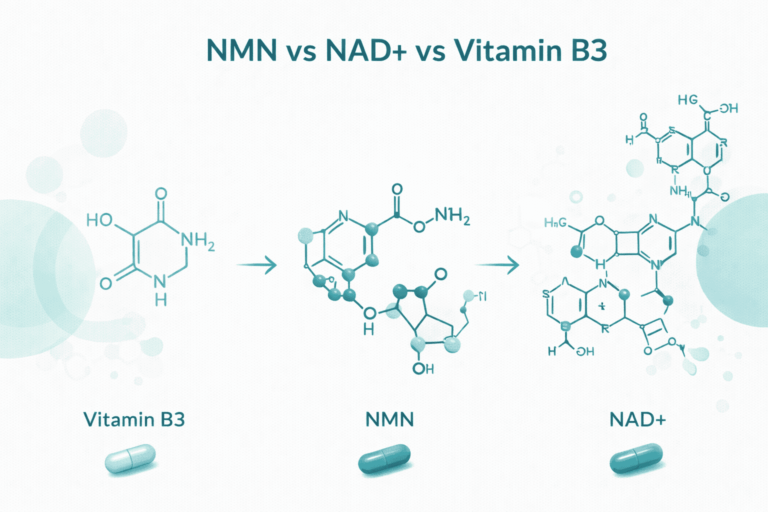
This is also consistent with how the trials themselves are designed: studies use continuous daily dosing throughout their measurement period, and none have reported diminishing effectiveness over the duration tested, which for most trials extends from 12 weeks up to around 12 months in a small number of longer observational cases. If you’re considering a planned break rather than stopping entirely, there’s currently no strong evidence either supporting or discouraging periodic cycling – it appears to be more a matter of personal preference and budget than something with a clear right answer in the research. For a deeper look at how NMN compares to related NAD+ precursors people sometimes switch to during a break, see NMN vs NAD+ vs Vitamin B3.
Setting Realistic Expectations
It’s worth being direct about this: NMN is not designed to produce an immediate, dramatic shift the way a stimulant or fast-acting medication might. The controlled research consistently points to a gradual, compounding pattern – modest early changes that become considerably more pronounced by the two-to-three month mark.
If you’re several weeks in and haven’t noticed anything, that doesn’t necessarily mean it “isn’t working” – the underlying biochemical trend in the available trial data suggests the most meaningful changes are still ahead at that stage, not behind you. Equally, if you stop before the 8–12 week mark commonly used in research, you may be discontinuing before the timeframe where the clearest, most replicated results have actually been documented.
The Bottom Line
Based on the clearest available human trial data: measurable NAD+ increases begin within the first month (11.3% by day 30 in one detailed trial), roughly triple by the two-month mark (38% by day 60), and metabolic and performance-related outcomes tend to become most apparent in the 6–12 week window across multiple independent studies. If you stop, the general pattern – based on mechanism and consistent reporting rather than dedicated trial data – is a gradual return to baseline over several weeks, without evidence of withdrawal effects. The most consistent theme across the research is patience combined with consistency – daily use sustained across at least 8–12 weeks appears to be where the clinical evidence base is strongest, rather than any shorter window.
This article is educational and does not constitute medical advice. Individual results vary, and this content should not be interpreted as a guarantee of specific outcomes or timelines.